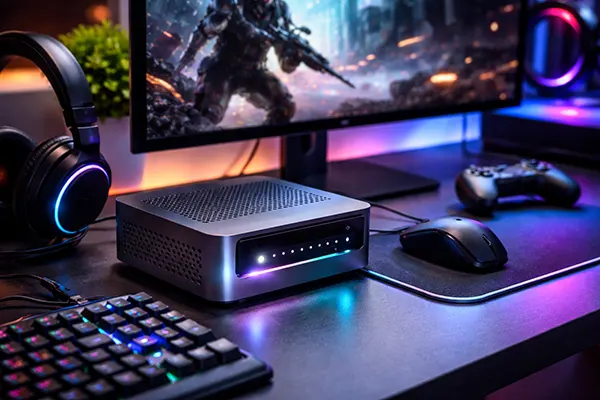
Mini-PC for Gaming in 2025: Can Compact Systems Replace a Classic Gaming PC?
The gaming hardware market in 2025 looks very different from what it was even five years ago. Alongside full-size desktops and consoles, compact Mini-PC systems have moved from niche devices to serious contenders for everyday gaming. With modern Ryzen and Intel processors offering increasingly capable integrated graphics, many gamers are questioning whether a traditional tower is still necessary.
Real-world gaming performance of modern Mini-PC hardware
In 2025, most gaming-oriented Mini-PC systems are built around AMD Ryzen 7 and Ryzen 9 mobile processors or Intel Core Ultra chips with advanced integrated GPUs. AMD’s Radeon 780M and 890M graphics, as well as Intel Arc-based iGPUs, are no longer limited to casual titles. They are designed to handle modern game engines with acceptable frame rates at reasonable settings.
Benchmarks and hands-on tests show that Mini-PCs equipped with Ryzen 7 8845HS or Ryzen 9 8945HS can run demanding games without thermal throttling, provided the cooling solution is well-designed. Dual-channel DDR5 memory plays a critical role here, as integrated graphics performance depends heavily on memory bandwidth.
Unlike early compact systems, current Mini-PC models are no longer restricted to office workloads. NVMe Gen4 storage, PCIe-based expansion, and proper power delivery allow these systems to behave much closer to traditional gaming PCs than their size would suggest.
Ryzen and Intel iGPU capabilities in practice
AMD’s integrated graphics currently lead the Mini-PC segment. Radeon 780M and 890M GPUs are capable of running many AAA titles at 1080p using medium settings, often reaching stable 40–60 FPS with modern upscaling technologies such as FSR.
Intel has significantly improved its integrated graphics through the Arc architecture. Core Ultra processors offer better driver stability and stronger performance in DirectX 12 titles than previous generations. While raw power still trails AMD in some scenarios, Intel iGPUs perform well in esports and optimisation-friendly games.
In practical terms, this means Mini-PC owners can expect consistent gaming results without relying on external GPUs, as long as expectations are aligned with integrated graphics limitations.
What games Mini-PCs can realistically handle at 1080p
At 1080p resolution, Mini-PC gaming in 2025 is no longer theoretical. Popular esports titles such as Counter-Strike 2, Valorant, Fortnite, and Rocket League run smoothly at high settings, often exceeding 100 FPS depending on the configuration.
Single-player games place heavier demands on hardware, but even here Mini-PCs show solid results. Titles like Elden Ring, Cyberpunk 2077, Baldur’s Gate 3, and Hogwarts Legacy are playable at medium settings with stable frame pacing when modern upscaling features are enabled.
Ray tracing remains the main limitation. While technically available on some integrated GPUs, performance drops significantly. Most Mini-PC users will disable ray tracing in favour of smoother gameplay.
Settings optimisation and upscaling technologies
FSR, XeSS, and temporal upscaling have become essential tools for Mini-PC gaming. These technologies allow games to render internally at lower resolutions while maintaining visual clarity on a 1080p display.
Careful adjustment of shadows, volumetric effects, and post-processing often delivers better performance gains than lowering texture quality. Since integrated GPUs share system memory, keeping textures at moderate levels helps avoid memory bottlenecks.
With correct optimisation, Mini-PC systems provide a consistent and visually acceptable gaming experience that suits most players outside the competitive ultra-high-refresh segment.
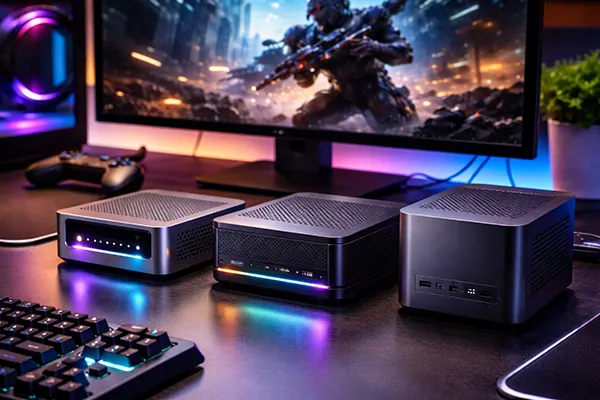
Advantages and limitations of Mini-PCs for gamers
The most obvious advantage of Mini-PCs is size. These systems fit easily into small living spaces, home offices, or travel setups. Power consumption is also significantly lower than full-size gaming rigs, which matters for long-term use.
Noise levels have improved as well. High-quality Mini-PC models now use advanced cooling designs that remain quiet even under sustained gaming loads. This makes them suitable for shared environments where traditional desktops can be disruptive.
However, compact design still imposes limitations. CPU and GPU upgrades are not possible, and users must carefully choose specifications at purchase. External GPU support exists but undermines the simplicity that attracts many users in the first place.
Who should and should not choose a Mini-PC
Mini-PCs are well-suited for gamers who prioritise space efficiency, moderate performance, and versatility. They work especially well for esports players, casual gamers, and those who value a clean, minimal setup.
Players targeting ultra settings, native 4K gaming, or heavy ray tracing will still require a classic desktop with a dedicated graphics card. Mini-PCs are not designed to replace high-end enthusiast systems.
In 2025, Mini-PCs represent a practical middle ground between consoles and traditional PCs, offering flexibility and real gaming capability without unnecessary complexity.