
Direct Drive Racing Wheels in 2026: How to Choose Equipment for Racing Simulators
Direct Drive racing wheels have become an increasingly accessible option for sim racing enthusiasts who want more accurate steering, realistic vehicle handling and greater control over their virtual cars. In 2026, manufacturers offer equipment ranging from compact, relatively affordable wheelbases suitable for home desks to professional systems designed for dedicated racing cockpits. Fanatec, MOZA Racing, Logitech, Thrustmaster and Simucube continue to develop their product ranges, giving drivers more opportunities to assemble a simulator that matches their budget and preferred racing disciplines. However, choosing the right equipment requires more than comparing motor power or manufacturer specifications. Steering response, pedal quality, mounting stability, software compatibility and the availability of interchangeable accessories all influence the driving experience. Understanding these differences helps buyers invest in equipment that provides practical benefits without paying for unnecessary features.
Direct Drive Technology and Its Advantages in Sim Racing
A Direct Drive racing wheel uses an electric motor connected directly to the steering shaft, eliminating the belts and gears found in many traditional force feedback systems. This arrangement allows the motor to transmit steering forces without additional mechanical transmission components. When a virtual car encounters uneven asphalt, runs across a kerb or begins to lose grip during cornering, the racing simulator calculates the relevant steering forces and sends corresponding instructions to the wheelbase. The driver can then feel changes in resistance through the steering wheel. The quality of these sensations depends on both the equipment and the accuracy of the simulation, making Direct Drive particularly valuable in racing games with sophisticated vehicle physics.
Conventional gear-driven racing wheels remain suitable for recreational driving, especially when affordability and convenient installation are priorities. However, their internal mechanisms can introduce noticeable vibration, mechanical noise and less natural transitions between different steering forces. Belt-driven models generally provide smoother movement, although the belt can absorb some of the finer feedback effects. Direct Drive removes these particular transmission limitations, allowing manufacturers to achieve more immediate and precise steering responses. This does not mean that every Direct Drive model automatically performs better in every situation, since motor design, software calibration and build quality also play important roles.
The practical advantage becomes particularly noticeable when driving close to the limits of tyre grip. During a fast corner, subtle changes in steering resistance can help the driver recognise developing understeer or oversteer and respond with an appropriate correction. Rally enthusiasts may benefit from more clearly defined changes in road surface, while circuit racers can use consistent feedback to refine their cornering technique. These improvements do not guarantee faster lap times, but they can make vehicle behaviour easier to interpret. For drivers who regularly practise in racing simulators, the additional information delivered through the wheel can support more consistent and controlled driving.
Understanding Torque and Force Feedback Strength
One of the most frequently advertised specifications of a Direct Drive wheelbase is torque, measured in newton metres (Nm). It describes the rotational force that the motor can generate rather than the overall quality of the steering system. Entry-level models generally offer around 3–5 Nm, while equipment in the 8–12 Nm range provides greater resistance and additional room for stronger feedback effects. Advanced wheelbases can deliver 15 Nm or considerably more. Buyers should also distinguish between sustained torque and brief maximum output, as manufacturers do not always present these figures using identical measurement methods. Comparing headline numbers without considering their meaning can produce misleading results.
For most home racing enthusiasts, a wheelbase offering approximately 5–12 Nm provides a reasonable balance between steering strength, comfort and equipment cost. A compact 5 Nm model can offer sufficiently detailed feedback for casual racing and regular practice, particularly when upgrading from a gear-driven wheel. Models delivering 8–12 Nm provide additional headroom, helping preserve differences between moderate and stronger steering forces when feedback is configured correctly. This can reduce clipping, which occurs when the requested force exceeds the available motor output and different feedback effects become difficult to distinguish.
Higher torque is not necessarily more comfortable or realistic. Excessive steering resistance can cause fatigue, interfere with quick corrections and make longer races physically demanding. Powerful wheelbases should therefore be configured according to the driver’s physical comfort, steering wheel diameter and preferred vehicle category. Open-wheel racing cars, touring cars and rally vehicles may require different feedback settings. Starting with moderate resistance and gradually adjusting individual parameters is generally more useful than immediately enabling maximum motor output. Drivers should also follow the manufacturer’s safety instructions, particularly when using high-torque equipment capable of generating sudden steering movements.
Leading Direct Drive Racing Wheels Available in 2026
The sim racing equipment market in 2026 offers several established product ranges covering different budgets and driving requirements. Among the more accessible options is the MOZA R3, which delivers 3.9 Nm of peak torque and is available in an Xbox-compatible racing bundle. The MOZA R5 offers 5.5 Nm and is supplied in a package that includes a steering wheel, pedals and a table clamp. Thrustmaster provides another alternative with its T598, which features a Direct Axial Drive motor delivering 5 Nm of sustained torque, with additional output for brief feedback effects. The PlayStation and PC version is particularly relevant to drivers who want to upgrade their console racing equipment without assembling a complete simulator from separately purchased components.
Fanatec remains an important manufacturer in the intermediate and advanced equipment categories. Its CSL DD wheelbase delivers 5 Nm in the standard configuration, increasing to 8 Nm with the Boost Kit 180 power supply. The Gran Turismo DD Pro provides a similar upgrade option with additional PlayStation compatibility. An important development in May 2026 was the increase in available torque for the ClubSport DD and ClubSport DD+ through updated software, bringing their maximum output to 15 Nm and 18 Nm respectively. Logitech also offers competitive alternatives, including the RS50 with 8 Nm of peak torque and the PRO Racing Wheel with 11 Nm. Both incorporate Logitech’s TRUEFORCE technology, although the additional feedback effects depend on game support.
For experienced drivers assembling dedicated racing cockpits, the premium segment includes equipment capable of producing substantially higher steering forces. The Simucube 3 range comprises the Sport, Pro and Ultimate models, with specified maximum torque outputs of 15 Nm, 25 Nm and 35 Nm respectively. Fanatec’s 2026 Podium DD is another high-performance option, offering up to 25 Nm of holding torque. Such equipment is intended primarily for demanding simulator installations where mounting rigidity, detailed feedback adjustment and long-term upgrade potential justify the investment. However, the considerable price difference between intermediate and premium models does not necessarily translate into an equally significant improvement in lap times or everyday driving enjoyment.
Choosing Equipment According to Budget and Racing Discipline
Drivers purchasing their first Direct Drive racing wheel should consider complete bundles before looking at individual components. A wheelbase advertised at an attractive price may not include a steering wheel, pedals or mounting accessories, substantially increasing the final cost. Entry-level packages such as the MOZA R5 Bundle offer a practical starting point because the principal components are supplied together. For occasional racing, familiarisation with simulator physics and participation in amateur online competitions, a well-configured entry-level setup can provide sufficient functionality. Spending more on equipment is generally worthwhile when the driver can identify specific limitations in their existing setup rather than simply wanting a higher torque rating.
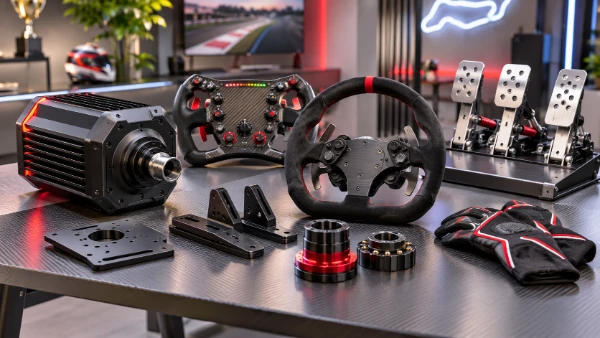
Racing discipline should also influence the choice of steering wheel and accessories. Drivers who predominantly compete in GT racing or Formula-style championships may prefer a compact steering wheel with accessible buttons and paddle shifters. Its shape makes it convenient to adjust traction control, brake balance and other supported vehicle settings during a race. Rally and drifting enthusiasts generally benefit from a traditional round steering wheel, which allows unrestricted hand movement during larger steering corrections. Drivers who regularly switch between different vehicle categories should consider a wheelbase with an interchangeable steering wheel system, allowing them to adapt their equipment without replacing the motor.
As an approximate planning guide, a budget of £300–£500 can cover some entry-level Direct Drive bundles, while £600–£1,200 provides more flexibility for assembling an intermediate setup with better pedals and accessories. Dedicated premium installations can easily exceed £1,500 before accounting for the cockpit, seat, displays and computer equipment. These figures are indicative spending ranges rather than fixed retail prices, since discounts, regional availability and package contents vary throughout the year. Reserving part of the budget for a sturdy mounting solution and dependable pedals often produces a more balanced simulator than allocating nearly all available funds to the wheelbase alone.
Compatibility, Pedals and Additional Sim Racing Equipment
Compatibility is one of the most important considerations when purchasing racing equipment in 2026. PC users generally have greater freedom to combine wheelbases, pedals, gear shifters and handbrakes from different manufacturers, provided that the individual devices have suitable connections and software support. Console users face more restrictions because their equipment must satisfy the relevant hardware licensing and communication requirements. A Direct Drive wheelbase designed for Windows PCs will not necessarily function with a PlayStation 5 or Xbox Series X and Series S. Even when a manufacturer offers console-compatible equipment, compatibility may depend on the exact wheelbase, steering wheel or accessory configuration.
Fanatec provides a useful example of these differences. The CSL DD does not offer native PlayStation compatibility, whereas the Gran Turismo DD Pro and ClubSport DD+ support PlayStation consoles. Xbox compatibility within the Fanatec product range generally depends on using a suitably licensed steering wheel. Logitech offers different versions of its racing equipment, and MOZA provides Xbox-compatible configurations alongside products primarily intended for PC users. Before placing an order, buyers should consult the manufacturer’s compatibility documentation and the supported-device information for their preferred racing games. This is especially important for players interested in Gran Turismo 7, iRacing, Assetto Corsa Competizione, Assetto Corsa EVO or Forza Motorsport.
Pedal quality deserves particular attention because braking consistency has a substantial influence on race performance. Standard pedals commonly measure pedal movement, while load cell brake pedals register the pressure applied by the driver’s foot. This makes it possible to develop a more consistent braking technique based on physical force rather than pedal position alone. The difference can become particularly useful during heavy braking, gradual brake release and corner entry. A driver choosing between a substantially more powerful wheelbase and an upgrade to load cell pedals should consider which component currently limits their performance. For competitive circuit racing, better brake control may offer more practical value than additional steering resistance.
Installing and Configuring a Direct Drive Racing Simulator
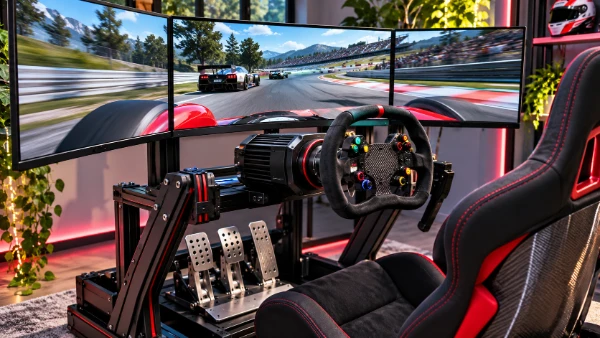
A Direct Drive wheelbase requires a stable mounting surface to deliver consistent feedback. Compact models can often be attached to a sufficiently strong desk using a manufacturer-approved table clamp, making them suitable for smaller rooms and multipurpose gaming spaces. However, more powerful systems are generally better suited to dedicated wheel stands or racing cockpits. Movement in the mounting structure can absorb steering feedback, introduce unwanted vibration and reduce driving precision. Buyers should verify that their chosen stand supports the wheelbase’s mounting arrangement and expected forces rather than assuming that every sim racing cockpit can accommodate high-torque equipment.
Once the hardware is securely installed, attention should turn to software configuration. Applications such as MOZA Pit House, Logitech G HUB, Fanatec’s software and Simucube Tuner allow users to adjust supported settings and manage firmware. Initial configuration should include steering calibration, suitable rotation limits, pedal calibration and moderate force feedback strength. The settings available within the racing game must also be considered, as excessive feedback gain can reduce the distinction between important steering effects. Using manufacturer-recommended profiles as a starting point and adjusting one setting at a time makes it easier to identify changes that genuinely improve vehicle control.
Long-term comfort, maintenance and upgrade potential should complete the purchasing decision. The steering wheel should be positioned so that the driver’s arms remain slightly bent, with the pedals securely mounted and accessible without excessive stretching. Cables should be arranged away from moving components, and ventilation around the wheelbase must remain unobstructed. Buyers should also check warranty conditions, replacement part availability and compatibility with future accessories. A well-balanced Direct Drive simulator does not need to contain the most expensive components available in 2026. It should provide predictable steering, dependable braking, comfortable seating and reliable operation across the racing games the owner actually uses. Equipment that meets these requirements represents a more worthwhile investment than hardware selected solely for its maximum power output.