
Resident Evil Requiem: How Two Protagonists Change the Survival Horror Formula
Resident Evil Requiem approaches the long-running survival horror series from an unusual direction: instead of forcing horror and action into the same style of play, it gives each side of Resident Evil its own protagonist. Released on 27 February 2026, the ninth main entry follows FBI analyst Grace Ashcroft and veteran government agent Leon S. Kennedy through connected events linked to Raccoon City and the wider legacy of the 1998 disaster. Grace represents vulnerability, uncertainty and careful survival, while Leon brings the experience, weapons and confidence expected from a character who has spent decades confronting biological threats. The result is not simply a campaign with two playable leads. Requiem repeatedly changes the player’s relationship with danger, resources and combat depending on who is on screen. That contrast becomes the organising principle of the game, allowing Capcom to place slow survival horror and forceful action beside each other without making either style feel like an occasional distraction.
Two Protagonists Create Two Different Kinds of Pressure
Resident Evil has spent much of its history moving between two identities. The original games built tension through restricted resources, locked rooms, puzzles and enemies that could be expensive to fight. Resident Evil 4 pushed the series towards faster combat and a much more capable protagonist, while Resident Evil 7 later restored vulnerability through first-person horror and confined environments. Requiem does not choose one of those traditions over the other. Grace and Leon allow both to exist within the same story, but crucially they are not given identical mechanics with different character models. Each has been built around a separate understanding of what makes Resident Evil tense.
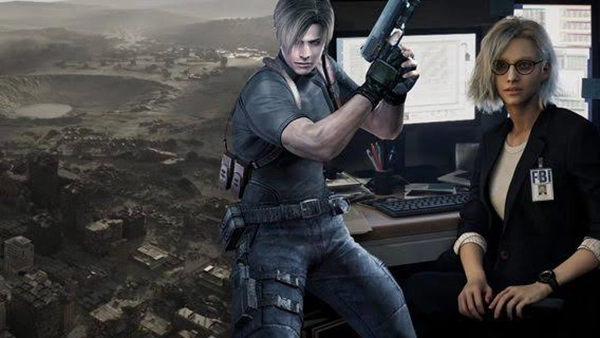
Grace is an FBI analyst rather than a hardened field operative, and the difference is immediately important. Her sections ask the player to pay attention to rooms, routes, ammunition and nearby threats because direct confrontation is rarely the safest first option. Her smaller inventory and comparatively limited combat ability make ordinary encounters meaningful. A corridor containing several infected enemies can become a problem that requires planning rather than another opportunity to clear a room. Grace gradually becomes more capable, but the game never forgets that she entered the crisis without Leon’s years of combat experience. Her fear is therefore part of the design rather than merely a feature of the script.
Leon operates at almost the opposite end of the scale. He is equipped for direct confrontation and can use a much broader combat vocabulary, including firearms, stealth attacks and a hatchet that functions as both a close-range weapon and a defensive tool. His experience changes the meaning of enemies that would force Grace to reconsider her route. With Leon, the player is more often encouraged to control a fight instead of escaping from it. Capcom compensates with more aggressive encounters and larger threats, but the underlying feeling remains different: Grace survives danger, while Leon is frequently capable of meeting it head-on.
Why the Contrast Matters More Than a Simple Character Swap
The important change is that Requiem does not treat the two characters like interchangeable campaign options. The story moves between them at predetermined narrative points, so the player cannot simply remain with whichever style feels more comfortable. Long stretches of restraint can give way to Leon’s more forceful encounters, and action can later be followed by another period in which ammunition, positioning and escape routes matter much more. Character switching therefore controls the emotional rhythm of the campaign as deliberately as enemy placement or level design.
This creates an effect that would be difficult to achieve with one protagonist. After spending time with Grace, Leon’s greater power feels more substantial because the player has recently experienced the same world from a position of weakness. The relationship also works in the opposite direction. After Leon has made fighting infected creatures feel manageable, returning to Grace removes that security. The game can make familiar types of danger threatening again without simply increasing enemy health or reducing weapon damage. It changes the player character instead, which is a much clearer and more natural way of changing the balance of an encounter.
Capcom reinforced this separation in areas beyond combat. The development team deliberately gave the two sides different musical identities, with Grace’s material supporting horror while Leon’s sections lean towards a harder and more energetic tone. That distinction matters because Requiem uses contrast rather than constant escalation. Horror does not have to become louder every hour to remain effective. Instead, the game provides periods of relative empowerment before taking that power away again. The transition itself becomes part of the tension.
Grace Rebuilds Classic Survival Horror Around Vulnerability
Grace’s story gives Requiem a useful reason to return to basic survival horror principles without pretending that every Resident Evil protagonist has forgotten how to handle a biological incident. She is the daughter of Alyssa Ashcroft, the reporter associated with Resident Evil Outbreak, and her investigation takes her back to the circumstances surrounding her mother’s death. Eight years after Alyssa was killed, Grace is assigned to investigate a new series of deaths connected to the same location. This personal connection gives the game access to older Resident Evil history while keeping its central point of view fresh. Grace knows how to analyse information, but she is not initially prepared for the physical reality of the crisis around her.
Her mechanics reflect that background. Ammunition matters, inventory space requires attention and avoiding unnecessary fights can save resources for later encounters. Requiem also gives Grace the Blood Collector, which allows her to gather infected blood from the environment and defeated creatures and use it within her crafting system. The mechanic creates an uncomfortable relationship between danger and survival: enemies are threats, but the material connected to them can also become a resource. On the Standard (Classic) difficulty setting, Grace’s sections even restore limited ink ribbons for saving, giving cautious players another reason to think before committing to a risky route.
The game does not turn Grace into a completely helpless character. She acquires weapons, learns how to defend herself and becomes more capable as events progress. The important point is the starting position and the pace of that growth. Players are given enough tools to make decisions without being given enough power to ignore their surroundings. Successful play therefore depends less on eliminating everything in a room and more on judging when combat is worth the cost. That brings resource management back to the centre of survival horror without simply copying the inventory and combat rules of the 1990s games.
Camera Choice Changes How Grace’s Horror Feels
Requiem also develops the contrast through camera perspective. Both Grace and Leon can be played in either first-person or third-person view, and players can change perspective rather than being locked into a single presentation for the entire campaign. Capcom nevertheless recommends first-person for Grace and third-person for Leon. The defaults match their roles particularly well: Grace’s closer perspective limits awareness of what is happening beyond the player’s immediate view, while Leon’s over-the-shoulder camera provides the wider spatial information that suits faster combat.
For Grace, first-person makes confined rooms and approaching enemies considerably harder to read at a glance. The player has to turn towards sounds, check corners and accept that something outside the current field of view may already be moving. Third-person provides more visual information and can reduce some of that uncertainty, but it does not rewrite Grace’s inventory, weapons or enemy encounters. The unusual benefit of Requiem’s camera system is therefore that players can alter how directly they experience the horror without changing the underlying campaign.
Post-release player behaviour also shows that the distinction was noticeable rather than theoretical. Director Koshi Nakanishi said in a 2026 interview that roughly 90 per cent of players were using third-person for Leon, while Grace produced a more divided result: around 60 per cent remained with first-person and about 40 per cent switched to third-person. Those figures fit the broader design. Leon has a well-established third-person combat identity dating back to Resident Evil 4, whereas Grace’s slower style can function from either viewpoint depending on how much visual proximity to the horror a player wants.
Leon Turns Familiar Resident Evil Action Into Part of the Horror
Leon’s sections could easily have felt like a separate action game attached to Grace’s campaign, but Requiem uses his capabilities as part of the same survival-horror structure. His hatchet can be used for close-range attacks, finishers, stealth takedowns and defensive parries, while his firearms make him far better prepared for large encounters. His crafting system is also more familiar, relying on materials such as scrap and gunpowder rather than Grace’s infected-blood mechanic. Even unusual weapons picked up during encounters can temporarily change the way he handles a room. These tools make Leon faster and more aggressive without making him mechanically identical to his Resident Evil 4 incarnation.
Power, however, does not mean the absence of pressure. Leon faces situations built for a character capable of fighting back, so the game can increase enemy numbers, introduce armed threats and demand quicker decisions. His sections are less concerned with making every bullet feel precious, but they still depend on positioning, timing and knowing when an enemy can overwhelm him. Requiem therefore avoids the simplest version of its concept, where Grace would represent horror and Leon would provide consequence-free action. Leon’s encounters remain dangerous; they simply produce tension through confrontation rather than helplessness.
The change in tone is especially effective because Leon arrives with decades of history attached to him. Raccoon City defined the beginning of his career in Resident Evil 2, making his return to events connected with the city more than a nostalgic appearance. Grace sees the consequences of past biological disasters from a relatively new perspective, while Leon represents someone who has lived with those consequences for most of his adult life. Putting them in the same story gives Requiem two ways to approach series history: one character has to understand what came before, while the other already carries it with him.
What the Dual-Protagonist Structure Means for Resident Evil
The most significant idea in Requiem is not that survival horror and action can coexist; Resident Evil has combined them many times before. The difference is how clearly the game separates them before making them support each other. Instead of trying to design every encounter as an equal mixture of scarcity and spectacle, Capcom can build a Grace section around avoidance, puzzles and limited resources, then build a Leon section around combat without pretending the same rules suit both characters equally well. The campaign gains variety while each individual sequence is allowed to have a stronger identity.
There is a trade-off to that structure. Players who strongly prefer one style cannot simply select Grace or Leon and remain with that character throughout the story. Someone attracted mainly to slow survival horror will eventually spend substantial time in action-focused encounters, while players interested primarily in Leon’s combat have to work through Grace’s more restrained sections. Requiem treats this friction as intentional. Its pacing depends on removing one form of comfort before the other can become routine, and the switch between characters is therefore as important as the mechanics available once control changes hands.
The commercial response suggests that the experiment reached a large audience. Capcom reported that Resident Evil Requiem passed six million worldwide sales by 16 March 2026, less than three weeks after release, making it the fastest entry in the series to reach that figure at the time. More importantly for the design of the series, Requiem demonstrates a way to preserve two very different Resident Evil traditions without flattening them into one compromise. Grace makes fear depend on uncertainty, restricted resources and personal vulnerability; Leon makes danger feel physical, immediate and confrontational. Moving between them turns the change in power itself into a survival-horror mechanic, which is the real reason two protagonists alter the familiar Resident Evil formula.