External GPUs via OCuLink for Gaming Laptops and Handheld PCs: A Real Alternative in 2026?
The idea of connecting a desktop-class graphics card to a portable device has existed for years, yet only recently has it begun to approach practical relevance. With the rise of compact gaming laptops and handheld PCs, alongside the emergence of OCuLink interfaces, the discussion in 2026 is no longer theoretical. This article examines whether external GPUs connected via OCuLink have become a realistic solution for gamers seeking performance without sacrificing portability.
What OCuLink Brings to External GPU Setups
OCuLink is a PCIe-based interface originally designed for enterprise storage, but its technical characteristics make it highly suitable for external GPU connections. Unlike Thunderbolt, which relies on additional protocols and introduces overhead, OCuLink provides a more direct connection to PCIe lanes. In practice, this means lower latency and improved bandwidth efficiency, especially when paired with PCIe 4.0 or PCIe 5.0 controllers found in newer hardware.
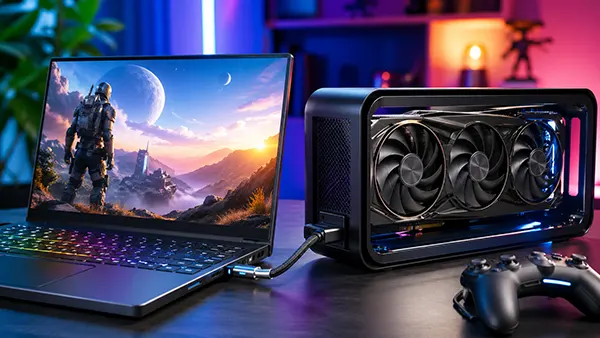
By 2026, several manufacturers have integrated OCuLink ports into gaming laptops and niche handheld PCs. Devices such as updated handheld gaming systems and modular laptops now offer direct PCIe access externally, allowing users to connect full-sized GPUs with fewer compromises. This shift is particularly relevant for enthusiasts who demand desktop-level performance but still value mobility.
Another important factor is cost efficiency. Thunderbolt-based eGPU enclosures remain expensive due to controller licensing and added circuitry. OCuLink-based solutions are often simpler, with fewer components between the GPU and the CPU. As a result, the total cost of building an external GPU setup has decreased, making it more accessible to a broader audience.
Performance Differences Compared to Thunderbolt eGPU
When comparing OCuLink with Thunderbolt 4 or USB4-based eGPU setups, the most noticeable improvement lies in bandwidth utilisation. Thunderbolt connections are typically limited to the equivalent of PCIe x4 lanes, while OCuLink can offer direct PCIe x4 or even x8 connections without protocol overhead. This translates into higher frame rates and more stable performance in GPU-intensive scenarios.
Real-world testing in 2026 shows that high-end GPUs connected via OCuLink lose significantly less performance compared to their desktop counterparts. In some cases, the gap is reduced to around 10–15%, whereas Thunderbolt solutions often experience losses of 20–30% depending on the workload. This makes OCuLink particularly attractive for modern AAA titles and demanding applications such as ray tracing.
However, performance still depends on system configuration. CPU limitations, memory bandwidth, and thermal constraints of the host device can all affect the final outcome. While OCuLink reduces one major bottleneck, it does not eliminate all constraints associated with portable hardware.
Compatibility and Practical Limitations
Despite its technical advantages, OCuLink is not yet universally adopted. In 2026, only a subset of gaming laptops and handheld PCs include native support for this interface. Many mainstream devices still rely on USB4 or Thunderbolt, which means users must carefully select compatible hardware before investing in an OCuLink setup.
Another limitation is physical design. OCuLink connectors are less standardised in consumer electronics compared to USB-based ports. Cable quality, connector durability, and enclosure compatibility can vary between manufacturers. This lack of standardisation may lead to confusion or compatibility issues, particularly for users unfamiliar with PCIe-based connections.
Power delivery is also a consideration. Unlike Thunderbolt, which can deliver power alongside data, OCuLink requires separate power solutions for both the GPU and sometimes the host device. This adds complexity to the setup, especially for users seeking a clean and portable configuration.
Ease of Use for Everyday Gaming
From a usability perspective, OCuLink setups have improved but still require a certain level of technical understanding. Plug-and-play functionality is not always guaranteed, particularly when dealing with BIOS settings, PCIe lane allocation, or firmware updates. Enthusiasts will find these challenges manageable, but casual users may find the process less intuitive.
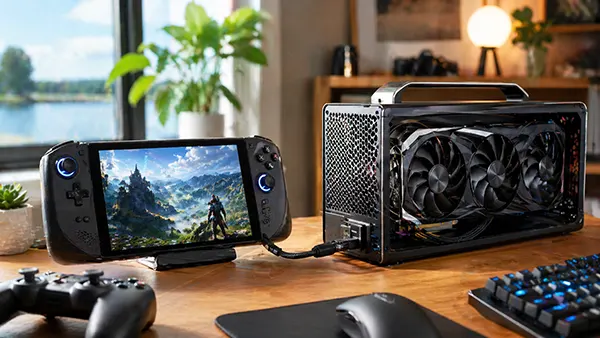
Handheld PCs present a unique case. In 2026, several handheld gaming devices support OCuLink through expansion ports or modular docks. While this allows for impressive performance gains at home, the setup undermines the portability advantage of these devices. Carrying an external GPU, power supply, and cables is not practical for on-the-go gaming.
Nevertheless, for hybrid use cases—such as using a handheld device as both a portable console and a desktop replacement—OCuLink offers a compelling solution. Users can enjoy mobility during travel and connect to a powerful GPU when at a desk, effectively combining two roles in a single device.
Is OCuLink a True Alternative in 2026?
By 2026, OCuLink has moved beyond experimental status and entered a phase of early mainstream adoption among enthusiasts. It addresses key limitations of previous eGPU technologies, particularly in terms of bandwidth and latency. For users who prioritise performance, it represents a clear improvement over earlier solutions.
However, it cannot yet be considered a universal replacement for desktop gaming systems. Limitations in compatibility, setup complexity, and portability still restrict its appeal. Many users will continue to prefer traditional desktops for maximum performance without compromise.
That said, the trajectory is clear. As more manufacturers adopt OCuLink and standardisation improves, its role in the gaming ecosystem is likely to expand. For specific user groups—such as those with limited space or a need for flexible computing—it already provides a viable alternative.
Who Benefits Most from OCuLink eGPU Setups
OCuLink-based external GPUs are particularly well suited for users who require both mobility and high performance. This includes professionals who use gaming laptops for work and entertainment, as well as enthusiasts who prefer compact setups without sacrificing graphical power.
They are also relevant for owners of handheld PCs who want to extend the lifespan and capabilities of their devices. Instead of replacing hardware entirely, users can upgrade performance through an external GPU, making the investment more sustainable over time.
Ultimately, OCuLink is not a one-size-fits-all solution, but in 2026 it has become a credible option within a specific niche. Its continued development will depend on wider industry adoption and improvements in user experience, both of which are already underway.